Interview: Sarina Nihei
- Interviewer
- Daisuke Tanaka
- Composer
- Takaaki Nomura
- Translation of a text
- New Deer
Could you tell us what first made you start creating animation?
Sarina Nihei (hereafter Nihei): There were two main turning points. The first was a class I took in my sophomore year of university, taught by Professor Masahiro Katayama. I originally entered the Graphic Design Department at Tama Art University wanting to become a graphic designer, but taking Professor Katayama’s class sparked an interest in animating my own drawings.
The second was discovering the work of Priit Pärn. I first learned about him through Koji Yamamura’s blog, “Unknown Animations.” When I watched Pärn’s work, a desire sprouted within me—not just to make drawings move, but to craft animation as a true artistic work.
Professor Katayama was also your academic advisor, right? What kind of things did you learn at Tama Art University?
Nihei: Professor Katayama’s class style was to watch international independent animation, create our own works, and then receive feedback. Rather than teaching animation technique itself, his approach was about watching actual works, thinking for ourselves, and translating that into our own projects—which suited me perfectly.
Also, the curriculum at Tama Art University thoroughly drilled the fundamentals into us during our freshman and sophomore years, which greatly strengthened my drawing skills. For example, in our first year, there was a class where we copied the styles of masters like Rembrandt and Dürer using acrylic gouache or charcoal, and in our second year, we studied typography and editorial design. We had a huge workload right from year one, and I think the experience of meeting those tight deadlines still serves me well today.
After graduating in 2012, you went on to pursue a master’s degree in animation at the Royal College of Art (RCA) in London. Why did you choose the RCA?
Nihei: Even before entering university, I had wanted to study abroad. I chose the RCA because it had produced so many fantastic animation directors—such as Jonathan Hodgson, Petra Freeman, Run Wrake, and Stuart Hilton—and I was also drawn to its curriculum.
What kind of tutors and students were at the RCA back then?
Nihei: My first-year tutor was Joe King, an experimental filmmaker, and my second-year tutor was Tim Webb, known for A Is for Autism (1992).
There were people like Nicolas Menard, Marcus Armitage, Sophie Koko Gate, Jesse Collett, Joe Bichard, and Isaac Holland in my class. But Nicolas was actually on Visual Communication in the first year, and then transferred to Animation in his second year.
That’s a stellar lineup of names who are now active internationally. What was student life like for you among such an impressive crowd?
Nihei: The RCA was open even on weekends, except for a few days around the end of the year, so I went in every single day without fail to work on my animation. No matter when I went, there was always someone from my class there, and I was hugely inspired by their work ethic. Also, while my parents sent me an allowance, I had absolutely no financial leeway during my studies, so the desire not to lose to my wealthier classmates was another driving force (laughs).笑)。
After completing your master’s program in 2014, you participated in 2019 in “Open Workshop,” an artist residency run by The Animation Workshop (TAW) in Viborg, Denmark. Could you tell us about that residency?
Nihei: It was what you’d call an artist-in-residence (hereafter AIR) program—travel expenses weren’t covered, but they provided accommodation and a production studio free of charge. It’s a program with around 20 participants who usually stay for one to three months, but I ended up staying for nine months.
As for how I got into OW: back in 2018, I participated in a one-month AIR called “Nippon Nordic,” which was hosted at the same location as OW. Participants spent their stay developing their own project proposals, and on the final presentation day, producers and industry figures from Denmark and across Europe gathered as judges while we presented our work. I presented the concept for Polka-Dot Boy, which was still in development at the time, and won the special prize of a “nine-month residency at OW,” which made my participation in OW possible.
On a side note, “Nippon Nordic” was also what originally led to my first encounter with Emmanuel-Alain Raynal from MIYU Productions, who produced Polka-Dot Boy. The Viborg Animation Festival was held during the final week of the residency, and he happened to be there as well. I reached out to set up a meeting with him, where I talked about Polka-Dot Boy, which was still in its early stages. After that, we kept running into each other at events like the Annecy International Animation Film Festival and the New Chitose Airport International Animation Film Festival, and I updated him on my progress each time. Then around 2019, when production was reaching its critical phase, he reached out asking, “How’s that project coming along?”—and that led to him joining the project as a producer.
TAW’s “Open Workshop” is world-renowned, so competition must have been fierce. What other artists were there besides you?
Nihei: Artists like Nikita Diakur, Nienke Deutz, and Lea Vidakovic were there. Also, because it was a long-term stay, toward the end my time there overlapped with the residencies of Sean Buckelew, Flóra Anna Buda, and Réka Bucsi.
Now I’d like to ask about your creative process. First, could you walk us through how you make a film?
Nihei: My works are rooted in the concept of violence caused by societal absurdity, as well as the anger and despair directed toward it. When I read or hear horrifying news that feels absurd, I develop that idea by putting my characters into situations where they experience it firsthand.
Once the relationships between characters and settings like opposing organizations are locked down, I create a timeline for each character and refine the storyboard based on that. Visuals come to mind alongside the story, so by the time I actually start drawing the storyboard, I can already play the entire film in my head from start to finish. Composition, angles, and even the pacing of the animation are all decided at this stage.
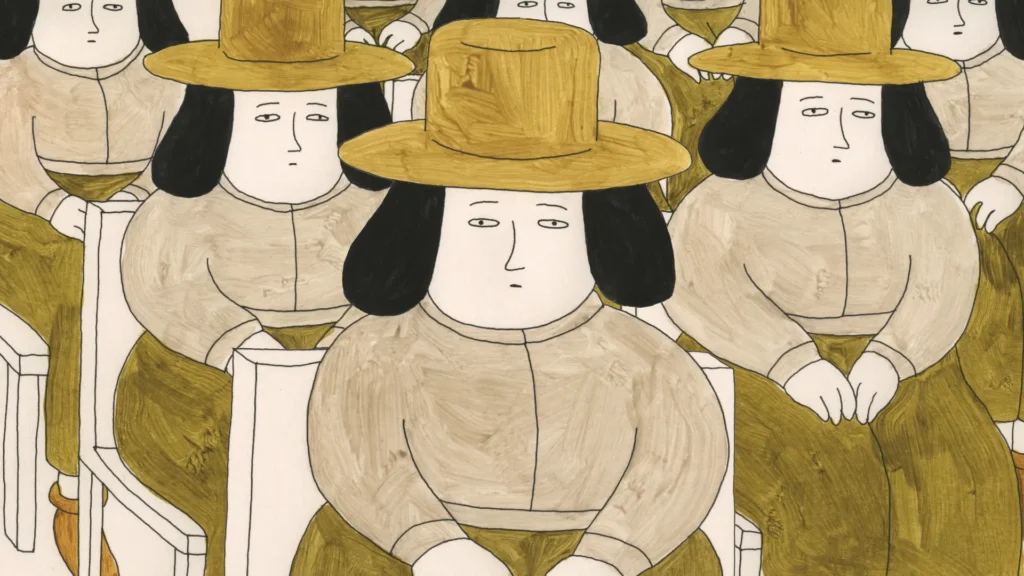
However, I often don’t decide on colors until the very final stage. I might pick a few key colors, but I don’t set the detailed palette right away. That said, during presentations at the RCA, they would always ask, “Why this color here?” So for my graduation film Small People with Hats (2014), I assigned symbolic reasons even to the detailed coloring.
What do you prioritize or value most when making your work?
Nihei: I keep entertainment value strongly in mind so as not to bore the audience. Of course, no matter how entertaining it is, it’s meaningless if the theme doesn’t come across—nor is there any point in making a shallow film that can be fully digested in a single view. That’s precisely why I think storytelling conscious of “suspense” is key. I try to weave in “mysteries” that enjoyably engage the viewer and withstand repeated viewings, all while conveying core themes like absurdity and violence.
Is there a film where you felt you achieved that focus best, or one you consider a turning point?
Nihei: The project where I felt I accomplished what I set out to do was definitely my graduation film, Small People with Hats. The deadline for graduation was tight, but thanks to going to school every single day to work on it, I finished a week early. Having that extra time allowed me to stare down the completed film and relentlessly search for areas to improve.
That said, I feel just as confident about my post-graduation films, Rabbit’s Blood (2017) and Polka-Dot Boy (2020). When I talk to artists around the world at film festivals, the films they point to as their personal favorites are always completely different.
In addition to your independent films, you’ve also done a lot of commissioned work. How did you get started with commissions?
Nihei: It started when I posted Small People with Hats on Vimeo. Someone wrote an article about it, and people who watched the film through the link in that article began reaching out with work requests.
Is there a difference for you between independent projects and commissioned work?
Nihei: For music videos, I try to avoid bloody or poisonous directions as much as possible (laughs). The music video for Whitney’s “Polly” (2016) was particularly well-received, and I’m really glad I did that job. Also, I recently created a station ID for Hulu; they told me I could do whatever I wanted, and since I was in charge of the horror segment, they allowed some pretty grotesque expressions, which was really fun to make.
Could you tell us about the tools you use in your production?
Nihei: First, I animate using pencil on regular printer paper. Once I get good movement, I use a lightbox to trace and clean up the drawings onto slightly thicker paper using a ballpoint pen. I’ve been using the exact same paper for clean-up from Small People with Hats all the way to the present. White paper ends up looking distinctly “paper-like” in color when scanned, but this paper has a slightly creamy tint, so it blends very naturally into a cinematic space.
For editing software, I’ve used Premiere Pro continuously since my time at the RCA. I used After Effects before that, but since my editing process doesn’t involve complex operations, I switched to Premiere Pro thinking something simpler would be better. I use Photoshop for color grading. Since I carefully design the color scheme during the coloring phase, I rarely make major adjustments during grading.
Finally, could you share some works or creators that have influenced you?
Nihei: I’ve loved movies since middle school and often went to TSUTAYA or GEO (Japanese video rental chains) to rent DVDs and VHS tapes. What shocked me most back then was Stanley Kubrick’s A Clockwork Orange (1971), and in the aftermath of that experience, I started watching art-house and indie films at local theaters once I hit high school. I was particularly drawn to David Fincher’s Fight Club (1999), as well as works by the Coen brothers, Roman Polanski, and David Cronenberg. Michael Haneke’s Benny’s Video (1992) also left a deep impression.
As for animation, I watched Ghibli films even before I started making animation myself, and I also liked Masaaki Yuasa’s Mind Game (2004) and Mitsuru Hongo’s Crayon Shin-chan: Great Adventure in Henderland (1996) / Unkokusai’s Ambition (1995). But in terms of influence as a director, Priit Pärn remains the biggest one.