Journals
September 25, 2026
First, please tell us what sparked your interest in animation.
KUDO Masa (hereafter, KUDO): As a child, I discovered I could create animation by repeatedly recording short clips with a video camera. Inspired by Pingu (1990–2006), which I watched on TV at the time, I created a yellow bird resembling a penguin and filmed it while moving it myself. It was truly fascinating. That was my first animation. Looking back, that experience was the catalyst for my interest in animation.
Did you specialize in animation at university?
KUDO: I studied at Hokkaido University of Education. As I was also involved in music, I wanted to pursue a career in either music or art. Unable to narrow down my path before the entrance exams, I chose this university because it offered a variety of classes. My major was Arts and Culture.
At the university, I primarily learned about animation from animation artist KURASHIGE Tetsuji and various types of moving images from video/visual artist ITO Ryusuke. In particular, watching the works of Zbigniew Rybczyński in class had a profound influence on my identity as a filmmaker.
Their classes introduced me to the world of independent animation and experimental film, and I began searching for and watching various works on YouTube and Vimeo outside of class. Among them, Georges Schwizgebel was particularly influential.
After graduating from university, you went on to the Image Forum Institute of the Moving Image (hereafter, the Institute). Did your encounter with experimental animation and film during your university years make you want to learn more?
KUDO: No, actually. I took a job in Hokkaido right after graduation and didn’t start attending right away.
While the internet made works easily accessible, even in regional areas, opportunities to see experimental works on the big screen are still concentrated in cities like Tokyo. Watching experimental videos online, my desire to experience them on a screen, enveloped in a movie theater’s darkness, grew daily. That’s when I remembered the Institute, which KURASHIGE-san had also attended. Thinking I could watch many experimental films and learn a great deal as a creator there, I decided to move to Tokyo and attend.
As your graduation project from the Institute, you completed your first animation work, Difference, Repetition and Coffee (2020). Your works leave a strong impression with their circular structures that contrast repetition and change, and it seems this style was already established by the time of Difference, Repetition and Coffee . Similar structures can be observed in the works of Schwizgebel and Rybczyński. While being influenced by preceding artists, you have masterfully sublimated them into your own style.
KUDO: Thank you. Difference, Repetition and Coffee received an unexpected response and was screened at many international film festivals.
The term “circularity” encompasses two methods: creating a spatial cycle by panning the camera 360 degrees, and creating a temporal cycle by overlapping the first and last scenes. I employ both, and in either case, the “circle” reflects my personal sense of reality. Our daily lives—the very way we live—may seem like a repetition, but in fact, they are slightly different each time, forming a cycle where minute differences appear and then vanish. I believe that is a universal principle.
Regarding my style, I am also influenced by the concept of “unity of theme and method” shared by SERIZAWA Yoichiro, who taught at the Institute. For example, in Tracing for Traces, which focused on a house, I used frottage to capture the textures and traces left there. Additionally, I created a work titled Blueprints for “The Solid” (part of Jouhatsu Letters), which utilized the cyanotype (blueprint) technique, formerly used for architectural drawings. The concept was to record memories not of the building’s beginning, but its end: its demolition and disappearance.
Are there any other artists who have influenced you besides those mentioned so far?
KUDO: In live-action, I am influenced by Andrei Tarkovsky and Theo Angelopoulos, drawn to their unique ways of capturing time. I also enjoy watching animations from the former socialist bloc, such as Yuri Norstein, Igor Kovalyov, Priit Pärn, and Ülo Pikkov.
You are currently enrolled in the master’s program at the Estonian Academy of Arts (hereafter, EKA). Ülo Pikkov, whose name you just mentioned, teaches at EKA. Was that a deciding factor for your study abroad?
KUDO: Yes, it was. Ülo Pikkov creates animation using various techniques and materials, and I felt I had much to learn from him.
However, the direct motivations were more about experiencing a world of animation I didn’t yet know and needing the time and environment to focus on production. The Estonian climate is well-suited for staying indoors and calmly focusing on creation.
Who are you primarily receiving guidance from?
KUDO: In addition to Ülo Pikkov, I primarily receive guidance from Anu-Laura Tuttelberg.
What is the student body like?
KUDO: Since it is an English-language course, the student body is international. Nationalities and ages are diverse, and the techniques used are varied, including 2D animation, puppet animation, and hybrids. What they share is a desire to experiment with various production styles.
What is the content of the classes?
KUDO: They teach a wide range of techniques. They encourage us to challenge ourselves with techniques we haven’t tried before.
The animation department has a large studio, and on its second floor is Nukufilm, a historic Estonian stop-motion animation studio. Professionals working there also run workshops. I had heard that once you enter EKA, you’ll want to do puppet animation, and that was exactly the case (laughs).
What tools do you use for production?
KUDO: Basically, I use a laptop, a scanner, a light box, and art supplies like acrylic paints. I keep my tools to a minimum so I can work anywhere and remain mobile. However, to better utilize the paper’s texture, I am considering shooting with a DSLR camera in the future. For editing, I use After Effects and Premiere Pro.
Looking back at the works you have produced so far, which one do you feel particularly successful with?
KUDO: Evaporating Letters (2023), a collaboration with Taiwanese experimental filmmaker Johan Chang. This work is a “video correspondence” between Ms. CHANG and me, exhibited at two locations: Shinjuku Ophthalmologist Gallery in Japan and Now Space in Taiwan. It has a structure that loops eternally without a fixed beginning or end. Although presented as an exhibition, I insisted it remain, above all, a “film” rather than a video installation. I pursued how to expand the “film” format into a white cube while maintaining its integrity. Personally, I feel that attempt was successful, and I have a sense of achievement.
Your new work currently in production, Sing by Ear, was born from your participation in the “Japan-EU Animation Residence” (hereafter, Japan-EU Residence) held as part of the “Osaka-Kansai Expo,” correct?
KUDO: That’s right. The Japan-EU Residence invited five animation artists each from Europe and Japan to stay in the Kansai region and give pitches at the Annecy International Animation Film Festival. As a side note, I first met animation artist Lucia Mrzljak, who teaches at EKA, at the Japan-EU Residence; she was also a participant.
Returning to the new work, the Residence provided opportunities to appreciate the traditional performing arts of the host region. Since I hadn’t had many opportunities to see Japanese traditional performing arts before, the experience was very fresh, and I decided I wanted to create a work based on them.
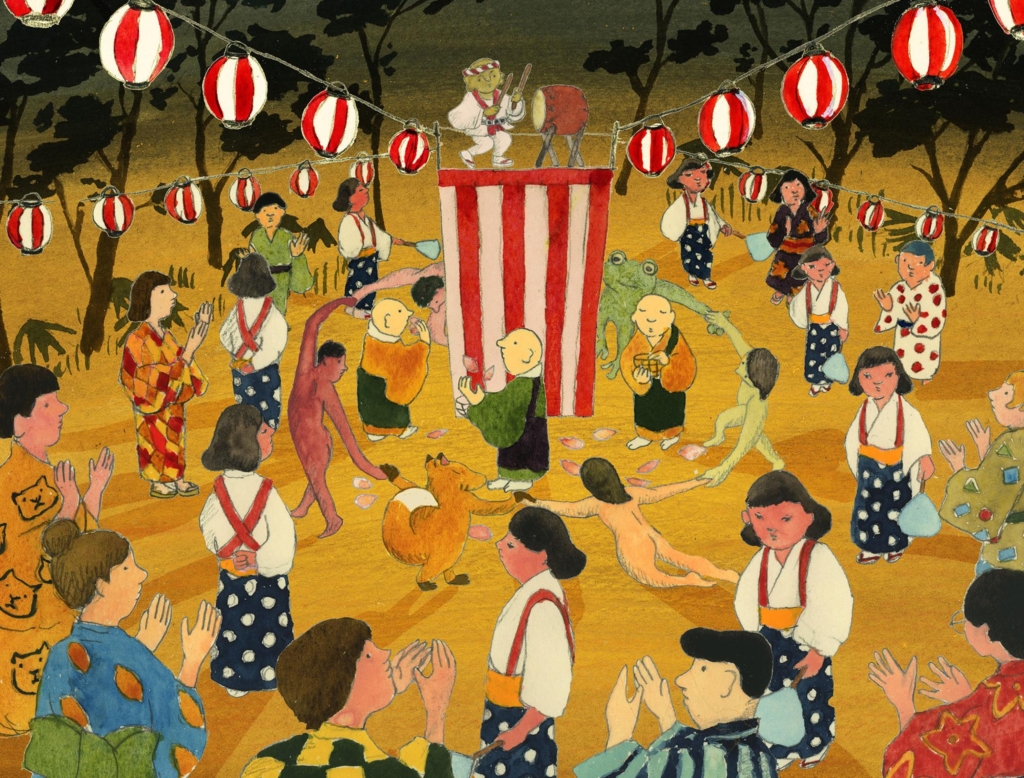
During my stay, I encountered various traditional performing arts, including Bunraku, Rōkyoku, and Kawachi Ondo, but the shōmyō (Buddhist chanting) I experienced at a temple was particularly impressive, and I am using shōmyō as the theme for my new work. Shōmyō is Buddhist music that developed from nembutsu (chanting the name of Buddha). The version I saw originated over 1,000 years ago and involved chanting scriptures while circling a Buddha statue inside a temple. There is a theory that this later evolved into the nembutsu odori and then the bon odori. Common to all these forms is a structure with a center, around which people dance or sing in a circle. I am currently producing the new work by focusing on that structure.
Until now, I believe you have been self-producing, but for the new work, you have welcomed KADOWAKI Kenji from Image Forum as a producer. How is the process of creating while running alongside a third party?
KUDO: Refining the work while receiving opinions from KADOWAKI-san and the advisors of “NeW NeW” is a fresh experience. Advice from an international perspective, in particular, is very helpful.
Furthermore—and this might deviate slightly from the question—another major change was considering the possibility of receiving financial support for my projects. I never had that idea before. I had a fixed notion that experimental film should act as a counter to commercial film by focusing on creating new and interesting expressions without spending money. However, working with a producer and attending lectures on grants and subsidies at “NeW NeW” helped me overcome those fixed notions. As a result, I feel I can approach the new work in a very open state.