Interview with OMAE Shohei – Selected Artist (Phase 2) of the NeW NeW project
- Interviewer
- Daisuke Tanaka
- Composition
- Yutaka Tsukada
- translation of a text
- New Deer
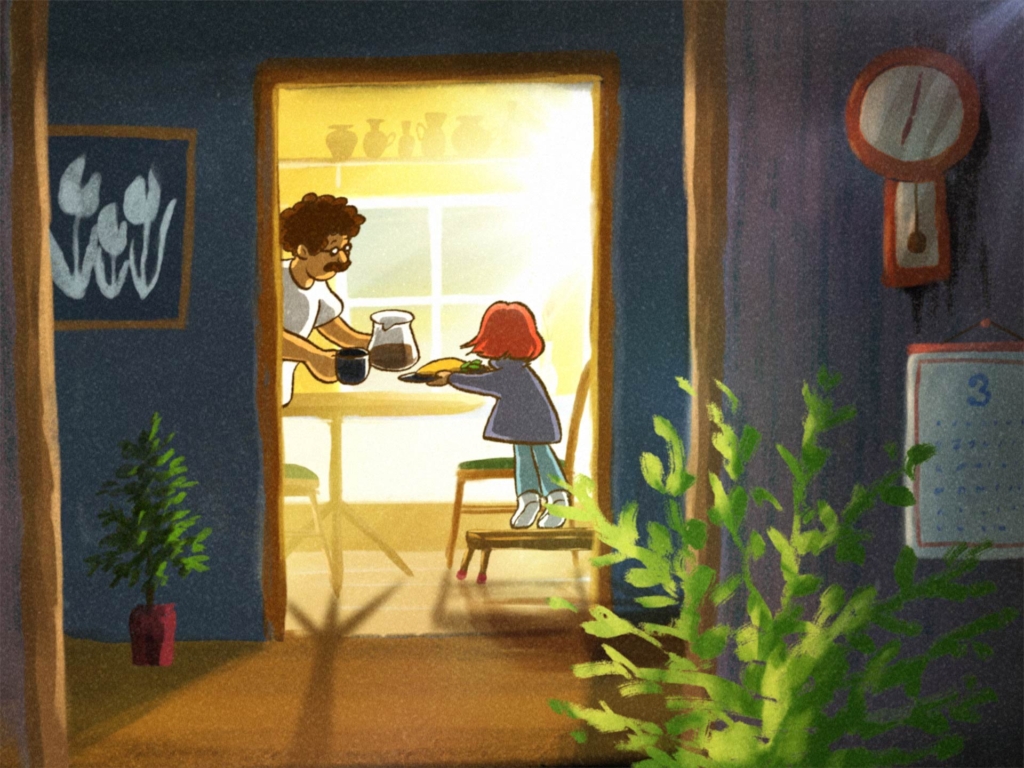
You have released many short animations on social media, but what was the original catalyst that started your animation production?
OHMAE Shōhei (hereafter, OHMAE): I used to work primarily in illustration, but I began to feel a sense of frustration that I couldn’t fully express daily scenes and emotions through static images alone. I thought that if I could make them move, I might be able to communicate them more effectively; that was the catalyst.
That said, at first, I didn’t even know how to make them. Nevertheless, while continuing to produce works through self-study, I was blessed with opportunities to come into contact with moving images, such as working part-time helping behind the scenes for television and stage productions, and working at a CGI animation production company for several years. While learning a great deal from those production sites, I gradually acquired the techniques of animation production.
Because I also liked movies and music, I had a strong desire to create works in conjunction with moving images. Although I’m not very good at social media, I started posting works there as a place for presentation, thinking I should first try making things move, even if they were short. I also have a feeling of wanting people to enjoy them in their daily lives, like a four-panel comic strip in a newspaper. Now, I’m gradually getting a handle on how to tell stories in my own way, and animation has come to feel right as my form of expression.
Did you like drawing pictures from the beginning?
OHMAE: Yes. I’ve liked drawing since I was a child. I wasn’t very good at communicating things with words, but I remember being recognized by those around me or making them happy through my drawings. The experience of being able to connect without speaking was what led me to become more deeply immersed in drawing.
Perhaps because of that, I feel your works often deal with the delicate nuances of daily life that cannot be expressed in words.
OHMAE: That’s right. The base is definitely “daily life”. I think the laughter, humor, and the beauty and strength of nature found there become my works. Furthermore, music is also an important element for me. While observing the small events around me and the transitions of nature, I want to scoop up the rhythms and signs flowing there. Through the layering of the bodies, spaces, and sounds depicted, I try to portray emotions and atmospheres that are hard to put into words, while also subtly weaving in the current events and social atmosphere of the time. I am searching for expressions that allow us to look at the world around us from a slightly different angle.
What are your sources of inspiration when producing works?
OHMAE: In my daily life, I often come up with stories triggered by casual things I happen to see or hear. Specifically, things like the changing of the four seasons, nature, city landscapes, and the casual gestures or expressions of people passing by. Other times, I receive inspiration from music, or from everyday sounds and sounds occurring in nature. I am also influenced by the current events and the social atmosphere of the time.
I feel a characteristic of your work is that social messages are embedded even within a soft style.
OHMAE: In recent years, unstable world situations due to wars and conflicts have continued, and disasters have also occurred one after another in various parts of the world, including Japan. I feel that opportunities to be made to think about such events are increasing even in daily life.
Because I haven’t directly experienced the damage of war or major disasters firsthand, I always have a conflict within myself about whether someone like me is allowed to depict war or disasters as a theme for a work.
Still, I face my works believing that there may be things that can be depicted precisely because I am in a position of not having experienced them as a direct party, and that there is meaning in passing down events and memories.
You mentioned that you liked movies from the beginning; what kind of works have you watched?
OHMAE: I have been greatly influenced by works depicting the tragicomedies of daily life and by comedians from all times and places. I have been drawn to a wide range of humor, from humor with strong physicality like slapstick to comedies that include social and dramatic elements. In particular, Charlie Chaplin’s works have left an impression on me. I find appeal in the way they combine slapstick elements with deep drama, where laughter and earnestness coexist. I also like director John Landis’s The Blues Brothers (1980).
In animation, I remember being very moved at the time by the exquisite combination of visuals and music in Disney’s Fantasia (1940).
Are there any people or works outside of film that have influenced you?
OHMAE: I think the Crazy Cats and the Drifters (both famous Japanese musical comedy groups) are very attractive in the way music and comedy are linked. I also really like ATSUMI Kiyoshi and Robin Williams because they express comicality through performance.
In illustration, I think Norman Rockwell’s depiction of people is truly magnificent. I was shocked by the skill with which the feelings and situations of the characters are conveyed in an instant within a single picture. In novels, it’s YAMAMOTO Shūgorō’s The Town Without Seasons (1962). I was attracted to the perspective that, even though it describes a tragic situation, it can somehow be read as a comedy. I also feel influenced by the laughter found in daily life depicted by SAKURA Momoko (famous Japanese manga artist and essayist).
By coming into contact with these works, my gaze toward the humor and pathos inherent in human activities was nurtured, and I feel that flows through the foundation of my own expression.
I think there is a richness of body language in your animation, and hearing your story now, I thought that might originate from Chaplin or Disney.
OHMAE: Yes. I think the influence of the works I saw and was moved by as a child remains strongly. Looking back, I conducted research on human emotions using motion capture during my university days, so I might be interested in the connection between emotion and physical expression.
In terms of humor within daily life, director TAKAHATA Isao’s My Neighbors the Yamadas (1999) also comes to mind slightly.
OHMAE: Thank you. This might deviate slightly from the question, but the way colors are matched and layered, and the way negative space is used, are very delicately designed, and I find it pleasant to watch. In fact, when I saw the making of director Takahata’s The Tale of the Princess Kaguya (2013), I remember being happy to feel that there were parts close to what I had been doing through trial and error, such as the handling of colors and the thinking behind negative space.
So that is how the soft visuals you draw were created. By the way, what software and art supplies do you usually use?
OHMAE: I basically work digitally. I mainly use Photoshop for drawing and coloring, and After Effects for editing. However, regarding color, I sometimes apply colors to a canvas with materials like oil pastels, photograph that, import it digitally, and use it as a texture.
How did you connect with João Espada, who is in charge of sound and music?
OHMAE: We connected via social media. Since he lives in Portugal, we communicate remotely. He will also be involved in my new project. I always ask him because his acoustic resonances and nuances match my taste.
You are involved in a wide range of activities, including client works such as music videos and illustration. What do you think about the differences between each?
OHMAE: I think they are all connected at the root, but I have a sense that the way of communicating and the content communicated differ slightly for each medium.
I believe short animations are things that depict and communicate scenes and emotions that I personally felt from a subjective perspective. In client work, music videos and advertising videos are things that, while staying close to the intentions of the client or artist, bring out the appeal of the work more richly through the synergistic effect created by the addition of moving images. I perceive illustration as something that stays close to the printed page or text, depicting scenes and sensations that arise by resonating with words.
Does client work ever lead to expanding your range of expression?
OHMAE: Yes. I feel that my range of expression is naturally expanding thanks to client work. When I’m producing alone, my expression tends to become limited, but I often discover new methods and ways of presentation while facing the contents of a request.
The balance between client work and independent production is an area where many artists seem to struggle. How about you, OHMAE-san?
OHMAE: I’m the type who concentrates completely on work once it comes in. However, I try to deliver early and make effective use of the time until the check-back to work on my own projects. By creating such a cycle, I secure time for independent production. Of course, it doesn’t always go that well (laughs).
Looking back on your career, is there a work that became a turning point?
OHMAE: It’s One Day (2021). This work was a major turning point that led to who I am today. It was also significant that it was selected for the New Chitose Airport International Animation Festival. Since I hadn’t been able to achieve results at film festivals until then, it was a great encouragement that the expression I had continued through trial and error was accepted as a single work.
My work was shown in a loop on a temporary display inside New Chitose Airport, and I was happy to see a man staring intently at my work until just before the airport closed. I think the appeal of film festivals is that you can get a direct reaction, unlike the internet. Also, being able to interact with other artists about animation at the venue was an experience I’d never had before.
Please also tell us about your new work currently in development as a selected project for NeW NeW, titled Whispers of Spring.
OHMAE: I’m still in the middle of refining the story, but what I want to depict is “family”. I hope to portray family time, affection, memories, etc., with humor mixed in.
It gives the impression of being a more complex story than your previous works and, overall, having scaled up significantly. Please tell us about these new challenges as well.
OHMAE: Throughout the whole piece, I want to make it a work that people can enjoy as a single film. I’ve always had a sense of inadequacy regarding scriptwriting, but I’m moving forward with production, taking it positively as a good opportunity to tackle a story with a single thread running through it.
Feedback from the NeW NeW advisors is also a good opportunity to look at the work objectively. It helps me realize when my intentions aren’t fully communicated, and I gain new discoveries when they suggest other approaches or references. While listening sincerely to advice, I want to approach the work with my own firm ideas so that the axis of my expression does not waver.