Journals
September 25, 2026
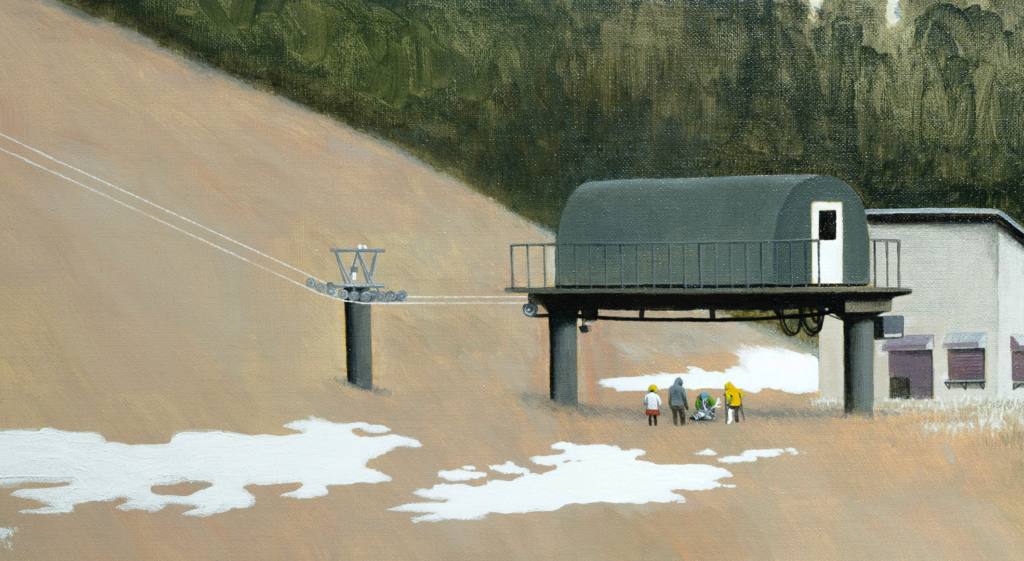
“Spiritual Songs of the Children”
When did you first start aspiring to follow the path of animation?
SAKAKIBARA Sumito (hereafter, Sakakibara): I believe it was when I was around 14 years old that I decided to create animation. However, even then, I wasn’t imagining a so-called commercial style. I was intuitively drawn to animation not simply as a means of self-expression or for its social value, but as something more fundamental—a medium for exploring time, life, and movement.
We understand you moved to the UK at the age of 15. Could you tell us about the circumstances surrounding your move?
Sakakibara: My family’s policy was that I would live away from my parents after graduating from junior high school, so I lived with the expectation that I would go somewhere else after graduation. Since my older sister was in the United States, there was initially talk of me going there as well, but due to visa issues and other factors, I ended up in the UK.
For graduate school, you enrolled in the animation course at the Royal College of Art (RCA) in the UK. Could you tell us about the atmosphere at the RCA at that time?
Sakakibara: Most of the other graduate students had gained professional experience before enrolling, so they were primarily in their late 20s to 30s. Since I went straight there from university, I was quite young.
There were many unique students, and it was interesting. Talent gathered from all over the world, and there was interaction with courses other than animation; the student body was diverse in terms of race as well. There was also a Japanese community. In the class one year above mine was MURAKAMI Hiromitsu, who was later involved in establishing the animation department at the Tokyo University of the Arts. I still hear from friends from those days occasionally.
What kind of educational program did the RCA have?
Sakakibara: Well… to be honest, I don’t have much memory of being “taught” anything. In the first place, I didn’t have the mindset of wanting to be taught something at the university. The attitude that one studies what is necessary on their own was pervasive among the students, and the faculty felt like figures with whom you would engage in debate on equal footing. Students would also critique each other’s work. I believe the RCA itself placed importance on creating a space where such open discussions could take place.
Please tell us about any artists or works that have influenced you. They don’t necessarily have to be animation.
Sakakibara: I have been influenced by many things. Since I also took film history lectures at university, I particularly enjoyed watching classic films.
However, the first thing that left a strong impression on me in my life might have been Georges Rouault, whom I saw when I was perhaps in the upper grades of elementary school. My parents took me to an exhibition on the way home from church. When I first saw Rouault, I thought, “The drawing is awful” or something like that (laughs). Nonetheless, even as a child, I felt something that couldn’t be put into words, and I remember being overwhelmed.
Currently, you have returned to Japan and are based in Nagano Prefecture. Why did you choose Nagano as your base?
Sakakibara: I am originally from Tokachi, Hokkaido, but after I moved to the UK, my parents, who work in the medical field, began working at a hospital in Nagano. Initially, it was meant to be a temporary stopgap until they could engage in medical work in Africa, but my mother’s health declined, and that became the catalyst for my parents to continue living in Nagano. Due to that connection, I have also lived with Nagano as my base for nearly 20 years since returning to Japan.
Do you basically do your production work at home?
Sakakibara: Yes. I paint with acrylics on canvas or panels in my workspace at home, photograph that with a DSLR camera, and then import it into Photoshop or After Effects for editing.
However, because raising children has been busy, there was a long period when I couldn’t focus intensively on production. I’ve only recently finally set up a proper space for working.
How do you balance child-rearing and production? This seems to be something many artists struggle with…
Sakakibara: Balancing them is difficult. To be honest, I don’t really understand how it’s even working. I’m not the type who can handle many things at once, so I sometimes get depressed when I can’t focus on production, but I also have the sense that when the time comes, things will naturally begin to move forward.
The coexistence of life and production always involves difficulty. However, fundamentally, I feel that hasn’t changed between the past and now. I feel it’s not quite right to say that you can’t produce unless you have ample time or financial resources, nor is it as simple as saying you can create good work as long as you have that surplus. Production and life are not things running separately; they are two sides of the same coin—or rather, they are things that weave a life together while intersecting. That is precisely why it’s about how to secure production time within the constraints—or rather, the conditions—of each life stage. I believe that’s all there is to it.
What kind of things inspire you to start producing?
Sakakibara: It’s like having a drawer in my head where everything I’ve seen and read is stored, and a sudden trigger opens it. While I sometimes do research for a work, I feel that more often, the initial catalyst is the accumulation of daily life suddenly taking shape in an unexpected moment.
A characteristic of your work seems to be that fragmentary details possess a loop structure, and these fragments relate to one another to constitute a larger loop. How do you design the relationship between the details and the whole?
Sakakibara: Even if we simply say “time,” it differs depending on whether you cut it as a single moment or over a long period like a year, doesn’t it? I try to grasp that multiplicity of time—or you could call it the multiplicity of the world—as a structure like a “Klein bottle”. It’s a state where the detail is the whole, and the whole is the detail. I suppose I could describe it as a sensation where each part blends together in a chaotic whole without linguistic articulation…
As for whether that is actually perceptible, it’s likely something that originally cannot be perceived. This also relates to the ambiguity of vision. Because I have poor eyesight, the world looks blurry to the naked eye, but I have a sense that even if I could see it clearly, I wouldn’t truly be “seeing” it in the real sense of the word. Whether viewing it nearsightedly or farsightedly, there are various perspectives, but I want to create an experience where a completely different layer emerges each time. I am interested in how the flow of the viewer’s mind involves itself in that.
Is the interpretation left to the viewer?
Sakakibara: Intellectual interpretation sometimes distorts a sincere gaze, but it is natural for people to find “stories” in everything, and I think it’s fair to say that is left to the viewer.
You present your works in a cross-disciplinary manner across multiple media, including not only film but also installations and manga. Please tell us the reason for this.
Sakakibara: Since I perceive production as an extension of things like cooking or chopping wood, for example, I don’t have the idea that the fields are divided when it comes to my own work in the first place. Therefore, I didn’t even have the awareness of “crossing” them.
However, I do think about the characteristics of the medium. For instance, if I want to leave brushstrokes, it becomes a painting or manga; if I need shifting time, it becomes animation. If I want to film a loved one as they are, it becomes live-action.
So you carefully consider the method depending on the theme.
Sakakibara: That’s right. I feel there was a time in the past when I sought a format that would serve as my footing, but as I have aged, I feel I have become more free.
Let me ask a question from a slightly different angle. It seems there is a difference in the “systems” that evaluate work between animation film and fine art. What are your thoughts on that?
Sakakibara: I believe there are differences in the critical language. However—and this is just my personal opinion—I feel that animation has hardly been “critiqued” at all. I have the impression that animation, within its own unique history, was absorbed into postmodernism without ever passing through modernism. On the other hand, fine art—especially contemporary art—has, since the mid-20th century, matured its own critical language while intersecting with thought, philosophy, and various social contexts.
However, I feel it’s also not quite right to produce work in a way that fits into such critical discourse; I suppose I don’t want to be imprisoned by such “systems,” or perhaps I am consciously trying not to be.
Finally, I’d like to ask a little about your new work in development, Children’s Hymn.
Sakakibara: Up until now, I have released two installation works that project animation onto a 360-degree screen. The new work will be the third piece following the same format, but I consider this approach to be a milestone for now. As a new attempt, I am incorporating a recitation by my friend and poet, NAKAO Taichi, into the work.
I heard that you plan to partially incorporate elements of dramatic film-style montage in the new work.
Sakakibara: That’s right. Since I will simultaneously produce a single-channel version as a short film, I plan to incorporate filmic editing, such as close-up cuts and things of that nature.
Furthermore, the film is being co-produced with Miyu Productions.
Sakakibara: I am grateful they reached out to me. Since our communication hasn’t fully begun yet, there isn’t much I can share at this point, but having lived in Europe for a long time, I don’t expect any issues in terms of communication.
It seems they learned about me through a film festival. I don’t create works with the awareness of evaluation from others, but since this ultimately makes it easier to work, I am always grateful to be evaluated.