Interview with Shiika Okada – Selected Artists (Phase 3) of the NeW NeW Project
- Interviewer
- Daisuke Tanaka
- Composition
- Yutaka Tsukada
- Translation of a text
- New Deer
What sparked your interest in animation?
Okada: My older brother, who is seven years older than me, studied film at Musashino Art University, where he was active in a group called ‘Kennja‘ with his friends. I had been watching their activities and works since I was in middle or high school, and finding them so interesting is what got me started.
Instead of going to a school that specialized in animation, you chose the Department of Intermedia Art at Tokyo University of the Arts (hereinafter referred to as Intermedia). What did you learn in Intermedia?
Okada: I was into photography in high school and was drawn to that path. However, because of my brother’s influence, I was also interested in film, so I chose Intermedia, where I could challenge myself with various forms of expression. I joined the lab of media artist HACHIYA Kazuhiko, where I learned to design concepts and engage in production work.
For graduate school, you didn’t continue at Intermedia but advanced to the university’s Department of Animation (hereinafter referred to as Animation Course). Did you want to learn animation more seriously?
Okada: In the Intermedia department, I was taught the importance of frameworks, context, and concepts for evaluating work, rather than just technical skills. On the other hand, my animation production was self-taught, so I wanted to relearn the technical aspects from scratch.
Also, since I was developing works as installations during my undergraduate years, I wanted to learn how to design single-channel works, so I chose the Animation Course. When I was in my third year, the Animation Course held a short-term lecture series for undergraduates, taught by professors such as YAMAMURA Koji. The content of those classes was one of the deciding factors.
Who was your supervisor during your time in the Animation Course?
Okada: After entering graduate school, I chose OKAMOTO Mitsuko‘s seminar because I wanted to delve deeper into planning and development, which is the stage before the actual production work. Through both undergraduate and graduate school, I learned the importance of carefully examining concepts before proceeding to production, which influences my current production style.
By the way, what kind of artists were your peers in the Animation Course?
Okada: I am in the 11th cohort. SOEJIMA Shinobu has been with me since our time in Intermedia. Others include WAKABAYASHI Moe and ISHIDATE Namiko.
What tools do you use for production?
Okada: I basically use Procreate and Photoshop for drawing, and Premiere for editing. However, I sometimes draw on paper or use analog materials like clay.
What part do you value most when creating your work?
Okada: I am always conscious of how the audience will feel, so that the work doesn’t become self-indulgent. That said, when I get absorbed in production, there are times when I can’t look at it objectively. I always struggle with the balance between being immersed in production and maintaining an objective perspective. That’s why I also value stopping to incorporate other people’s perspectives, such as having my family watch it along the way.
What do you start with when producing?
Okada: I start by writing down my experiences or themes that will become the seeds of the work. From there, I develop it into a text storyboard, which I then use to move on to a video storyboard. In that process, the visuals often solidify gradually.
How do you analyze your own creative interests?
Okada: I often use love and gender as themes, and that is intentional. I am constantly looking for parts where the theme of each work links with my own experiences.
Up until Maternal Awakening (2021), I had many works that were like self-documentaries. But by writing the script for the live-action film Kisspeptin Chronicles (2023), I started thinking about expanding into fiction rather than just depicting myself.
Even when your works deal with serious themes, your storytelling style is humorous.
Okada: That’s right. I always value humor. Since I often deal with heavy themes, I try to be conscious of designing the work in a way that serves as an entry point for the audience, rather than just depicting it seriously.
Please tell us about artists or works that have influenced you.
Okada: I am influenced by the contemporary artist Sophie Calle. As for animation, it’s the works of director TAKAHATA Isao. Only Yesterday is my bible. The structure of going back and forth between the present and the past has had a strong influence on my own work. Also, in terms of off-beat humor, I am influenced by the works of director MORITA Yoshimitsu.
Looking back at your career so far, which work was a turning point?
Okada: The My Boy Friend for Graduation Work (2018). I was able to win the Excellence Award at the Student CG Contest (now the Next Young Artist Award), which gave me confidence. That work ended up being the basis for the story of Kisspeptin Chronicles.
Boozy Woozy Wonderland (2019) was highly acclaimed internationally, including being selected for the Student Category at the Animafest Zagreb (hereinafter referred to as Zagreb). How was the international film festival?
Okada: When I was nominated for the student category in Zagreb, they provided me with a guesthouse. Since the students stayed there, we were able to deepen our friendships. Even now, I still keep in touch with the artists I met then. Also, what I remember about Zagreb are the VR works. The venue was an old tunnel in the city, and it was impressive that the VR works were placed after passing through the darkness. Animation was playing everywhere in Zagreb. The whole city was a stage for the film festival, which was fresh to me.
Before being selected for Zagreb, I had a complex about my drawing skills. There are many animation artists who are exceptionally good at drawing. However, being chosen for Zagreb convinced me that I could compete not just with drawings, but also with storytelling, which led to my confidence afterwards.
It is also worth noting that you are working on live-action films in parallel with animation. Could you tell us the circumstances of producing the live-action feature film Kisspeptin Chronicles?
Okada: Maternal Awakening won the Jury Special Prize at the 43rd Pia Film Festival (PFF). That gave me the right to apply for the PFF Scholarship (now PFF Produce Work). I had been interested in live-action for a while, but it requires a lot of manpower, so I felt it was a high hurdle. However, I thought I wouldn’t have a chance to challenge myself with live-action unless it was an opportunity like this, so I took the plunge and applied.
As a creator, how do you feel about the difference between animation and live-action?
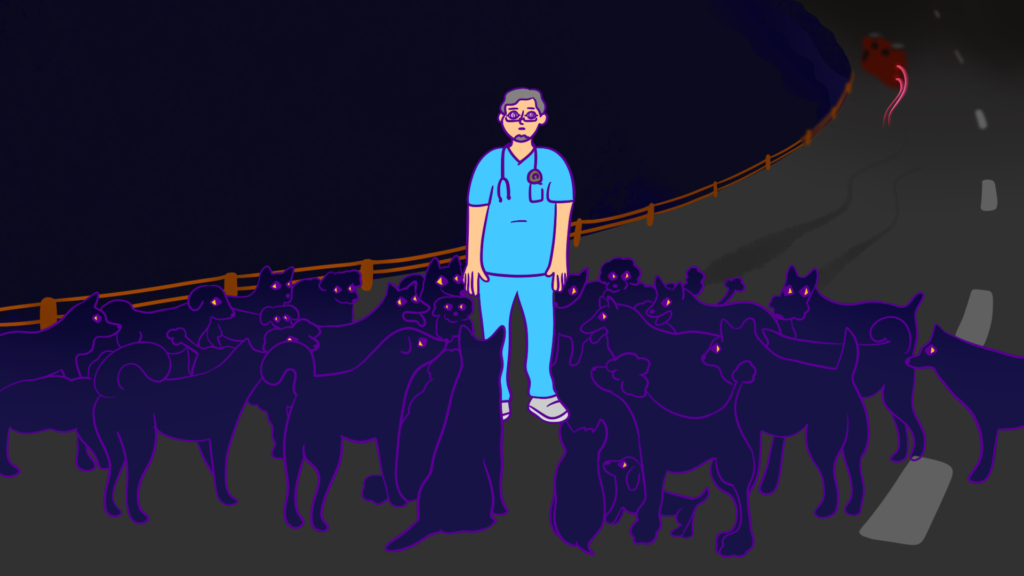
Okada: For example, in my current work, there is a scene where a lot of dogs appear. In live-action, you would need to consider whether it’s even feasible, but I thought it could be interesting in animation. Thinking about it this way, I think there are differences in the situations and themes suitable for live-action and animation.
Also, live-action is interesting because the approach to acting differs depending on the actor. There were those who built characters while discussing with me, and those who designed their acting according to the director’s instructions. The variety in approach isn’t limited to the acting department. It was stimulating to see the process of the work being shaped by the interpretations of each section, such as the cinematography and lighting departments. In independent animation, my image is output directly without passing through the filters of others, so that is also a big difference.
Are there any parts that were fed back into animation by experiencing live-action?
Okada: Yes, there are. Before that, there were many cuts from the front or the side, and I frequently used graphical screen designs to highlight the humor of the dialogue. However, in Happy Eyescream (2025), which I made after experiencing live-action, I began to be more conscious of spatial elements such as character acting and camera angles than ever before, even in animation. I think that is where my live-action experience is utilized.
Your most recent work, ‘Happy eyescream’, is produced by NOTHING NEW.
Okada: They let me make it quite freely. It was especially encouraging to receive various opinions in the planning and development stage.
‘Happy eyescream’ is a work that ironically depicts the process of a younger sister escaping from the control of her older brother, but it is based on my own experience. I have a good relationship with my brother, and he also cooperates with my production. However, at the same time, I was aware that I was too influenced by him. My brother is a cheerful person, and he has even introduced me to his girlfriend. Those episodes with my brother are reflected in the work. My brother was a close object of admiration, but I have also become an adult, and now I can see my brother as a person. I incorporated such changes into the work. By the way, my brother is participating as a co-writer in Kisspeptin Chronicles and the project I am currently working on.
Finally, please tell us about your new project Good Boy without Beard (tentative title), which is currently under development with the support of NeW NeW.
Okada: The protagonist is set to be born in 1989. In this year, Emperor Showa passed away, and for the first time, female college enrollment rates exceeded those of men. Many female candidates were also elected in the Tokyo Metropolitan Assembly election. It is also the year when violent crimes by men against women increased. Because of such a background, 1989 is also said to be the year when the collapse of the male society began in Japan. The protagonist carries such a historical background.
The boy’s father is a veterinarian in a rural area. He was also known in town as a “strong man.” In the hospital, castration surgeries for dogs and cats were performed every day, and the boy grew up amidst the painful cries of animals that had lost their penises. Afterwards, the story introduces the protagonist, who has grown up and become a father himself, returning to his parents’ home for the first time in a while for the castration surgery of his daughter’s pet dog.
The basis of this new work is my father’s experience. My father told me that he was mocked by those around him when he was cleaning up the corpse of a dog that had died in an accident. He told me that with tears in his eyes. Since that was the only time I had ever seen my father cry, it remained in my memory for a long time. I thought that the reason my father couldn’t cry in front of people might have been related to various social constraints as a man, as a husband, and as a father.
I think you have had many works from a female perspective so far. Why did you focus on the male perspective this time?
Okada: I had been working on works from a female perspective from the beginning, but that is related to the fact that I am female. However, I have always been interested in stories from a male perspective. By featuring a man trapped in the patriarchal system in Kisspeptin Chronicles, I thought I wanted to face such themes again. Since my brother happened to be born in 1989, I thought I could dig deeper into the theme by making a man, rather than a woman, the protagonist.
Are there any aspects of visual expression that you would like to tackle?
Okada: Thankfully, the advisors at NeW NeW evaluated my storytelling and also gave me advice on the possibilities of group production. What I want to challenge myself with this time is to lead the work to completion with the help of many people. Utilizing my experience in live-action, I have a desire to seriously tackle group production in animation. Also, in terms of technique, I think it is open to the possibilities of various approaches, not just traditional drawing animation, so I would like to work flexibly so that I can make better choices for the work.