Interview with Shinobu Soejima – Selected Artist (Phase 3) of the NeW NeW project
- Interviewer
- TANAKA Daisuke
- Composer
- TSUKADA Yutaka
- Translation of a text
- New Deer
I understand you lived in Malaysia until you went to university.
Soejima Shinobu (hereafter, Soejima): I was born in Japan, but due to my father’s work, we moved to Malaysia, where I spent most of my teenage years. I attended a British international school, so I grew up surrounded by friends from diverse backgrounds. Penang, where I lived, has a complex history shaped by both British colonial rule and Japanese military occupation. I believe this background deeply influences my current artistic practice and research.
You also attended University College London (UCL).
Soejima: Since many of my teachers were British, they recommended the Slade School of Fine Art at UCL. I decided to major in sculpture there.
However, spending time away from Japan made me reflect more on my roots and prompted a desire to return home. I ultimately left Slade after about a year and transferred to the Department of Intermedia Art at Tokyo University of the Arts (Geidai Intermedia Art).
At Geidai Intermedia Art, wanting to explore sculpture within the broader context of contemporary art, I joined Motohiko Odani‘s seminar. However, the Japanese art university context regarding sculpture work was far more traditional than I had anticipated. Throughout my undergraduate years, I struggled with the gap between what I envisioned creating and what I was actually able to produce.
What motivated you to start creating animation?
Soejima: Initially, I created installations and sculptures, but I was always drawn to storytelling. For my graduation project at Geidai Intermedia Art, I decided to try stop-motion animation, as it allowed me to combine my sculptural practice with narrative building. At first, however, I had no idea how to use Dragonframe—the industry-standard stop-motion software—or how to construct puppets. Since social media was not as prevalent then as it is now, I relied on books and scarce online resources, learning entirely through trial and error.
For graduate school, you chose the Department of Animation in the Graduate School of Film and New Media rather than continuing in Intermedia Art. Did you want to formally specialize in animation?
Soejima: Geidai Intermedia Art was an environment where I could experiment with various mediums, but I felt a strong need to focus on a specialized field to deepen my expertise. In graduate school, I joined Yuichi Ito‘s seminar and specialized in stop-motion. Unlike Intermedia Art, production here was primarily geared toward film festival screenings. Naturally, I was often bewildered by the differences in approach compared to contemporary art. Looking back, however, experiencing both distinct disciplines during my student years has been an invaluable asset.
Who were some of your peers at the time?
Soejima: Shiika Okada has been a close peer since my undergraduate days in Intermedia Art. Others include Moe Wakabayashi, as well as Asaki Nishino, Mayo Kobayashi, and Yumi Hirata, who formed the animation unit “Oh Hey Do.”
While in graduate school, you also spent time at the Royal College of Art (RCA) as a visiting researcher.
Soejima: I went there to research the work of Suzie Templeton, one of the primary figures who sparked my interest in animation, as the RCA was where she produced her works. I traveled to the UK with support from the “Tobitate! Study Abroad Initiative.”
Who did you connect with during your time there?
Soejima: First, Suzanne Buchan, a leading authority on the Quay Brothers who was teaching at the RCA. Through her introduction, I had the opportunity to speak with the Quay Brothers while they were producing Sanatorium Under the Sign of the Hourglass (2024). I vividly remember conversing with them in their studio—a space filled to the ceiling with books, with puppets from their past films resting atop the stacks—feeling utterly humbled by their immense knowledge and distinct worldview.
Outside the school, I was closely mentored by Paul Bush, who tragically passed away in an accident in 2023. After completing my research program, I interned at his studio for about two and a half months and worked as an animator on his final film, Orgiastic Hyper-Plastic (2020). We shared meals and built a warm, almost familial bond, so his passing was a profound shock. He was renowned for his signature technique of blurring outlines by replacing similar objects frame by frame, and I constantly reflect on how I can inherit and adapt that approach in my own work.
I also expanded my network by visiting Špela Čadež in Slovenia and volunteering at the Tricky Women/Tricky Realities Film Festival in Vienna. Throughout my stay at the RCA, I actively sought opportunities to engage with artists both inside and outside the institution.
You are currently enrolled in the Doctoral Program at Tokyo University of the Arts. What is your current research topic?
Soejima: My research explores how animation can depict “the invisible” and “that which has been rendered difficult to see,” re-examining the medium through the lens of animism.
“The invisible” relates to the historical roots of puppets—such as ritual Shinto effigies katashiro (effigies)—which were created to invoke spirits or absorb misfortune. Long before they became toys, puppets functioned as spiritual conduits bridging our world and the afterlife. I am investigating the potential of puppet animation to reveal these continuous connections and harmonize binary divisions—such as self and other, life and non-life, or center and margin.
“That which has been rendered difficult to see” refers to entities and individuals who exist but are socially marginalized or erased. It is impossible to fully comprehend or empathize with presences fading from history. However, under the guidance of Professor Taruto Fuyama, I am testing animation’s ability to invite these obscured states into the physical body of the puppet, attempting to re-narrate their experiences beyond a simple subject-object dynamic.
How would you describe or analyze your own artistic style?
Soejima: Many of my works reinterpret and re-narrate Asian folktales from my personal perspective. Another key characteristic is my deliberate use of organic materials—such as raw meat and rice—which are typically avoided in stop-motion animation due to decay over time. By incorporating perishable materials, my goal is not only to simulate movement through animation, but to harness the organic transformation of matter itself as an inherent form of animation.
The non-Western elements in your work also stand out. How do you view this aspect?
Soejima: I can explain this from two perspectives. First, rather than framing my work around a rigid binary of “Western” versus “non-Western,” it stems from a desire to focus on what is intimate and local to me. “The invisible” cannot be easily categorized, and attempting to depict unfamiliar traditions can risk cultural appropriation. By grounding my practice in cultural spheres close to my own experience, I can create with greater authenticity and conviction.
Second, the puppets themselves carry non-Western lineages. While modern stop-motion animation developed largely in the West, puppet performance has a deep history across Asia—such as Oshirasama rituals in Japan, Kuileixi (puppet theater) in China, and Wayang Kulit in Indonesia—where puppets served as vessels for communicating with the spiritual realm. While puppets are often viewed as objects devoid of free will, in these traditions they function not as objects to be controlled, but as mediators for engaging with forces beyond human control.
My initial motivation to pursue animation was tied to the loss of someone close to me. Animating a puppet felt like temporarily breathing life back into a state of death. That experience is likely why puppet animation remains my chosen medium.
It will be exciting to see how your practice develops beyond simplistic dichotomies.
Soejima: In that regard, having the opportunity to consult with Western advisors from the development stage at NeW NeW is invaluable. I want to effectively communicate the distinct cultural contexts underlying my work.
Looking back on your career so far, which project felt particularly milestone-worthy?
Soejima: My very first animation, The Spirits of Cairn(2018). It made me realize how puppet animation could serve as a way to confront loss and engage with things that are gone or difficult to grasp. It remains my personal benchmark to this day, and it holds a special place as the first work of mine screened internationally.
What principles do you keep in mind during the creative process?
Soejima: For every project, I assemble a research book compiling the events, images, and reflections that influenced me. Since these form the core inspiration of the work, I return to them whenever I feel lost. Relying on established philosophical frameworks or trends might make a project easier to explain, but it risks stripping away genuine creative tension. By grounding my work in personal triggers and experiences, I strive to maintain an authentic first-person narrative.
Could you share which artists have influenced you the most?
Soejima: First, as I mentioned earlier, Suzie Templeton. Watching her film Dog (2001), I felt a genuine sense of life breathing through the puppet, which opened my eyes to the power of animation.
I also draw inspiration from sculptor Toshikatsu Endo, who pursues the raw materiality of objects for proclaiming the “restoration of narrative”, and more recently, Taiwanese artist Zhang Xu Zhan (Hsu-Tsan Chang). Navigating between fine art and animation provides me with continuous insights.
You work across both cinema and fine art. How do you perceive the difference between the two mediums?
Soejima: Cinema assumes the audience will watch in linear chronological order, whereas in fine art installations, viewers control their own engagement with time, allowing for more active interaction. Therefore, when exhibiting, I design the spatial setup to offer yohaku (negative space) for the audience to process and respond. I often place screens at floor level and project life-sized imagery to create a seamless connection between the work and the surrounding space.
Conversely, in cinema, I can convey uncompromising emotions precisely because the audience is focused in a fixed environment. When dealing with elusive or difficult topics, the structured narrative of film can be particularly effective for communicating essential ideas.
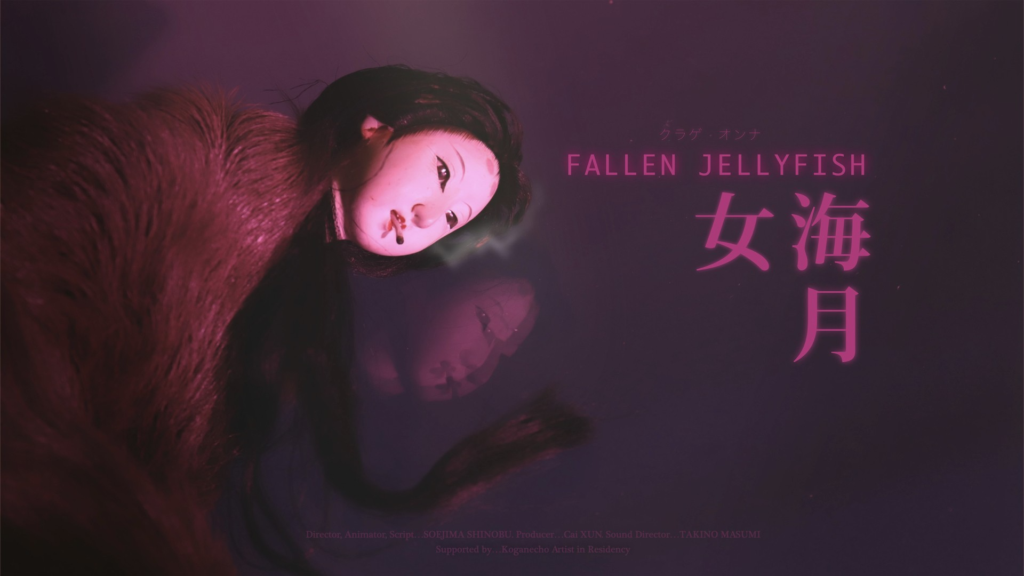
Finally, please tell us about your project in progress, Fallen Jellyfish.
Soejima: I am currently working out of a studio at the Koganecho Artist-in-Residence in Yokohama. Fallen Jellyfish focuses on foreign women who settled in this neighborhood. Koganecho has a layered history that changes depending on one’s perspective, yet the voices of these women have remained largely absent. My studio space itself was formerly part of a business in what was once known as the red-light district. While I can never fully project myself into the lives of those who occupied this space, relying on unexamined empathy or imagination can feel presumpuous. Balancing that self-awareness with my presence in this room, I feel compelled to imagine the lives of these marginalized women. Engaging with the town’s history and hearing complex local accounts made me feel an urgency, as a resident, to continuously confront and visualize their perspectives alongside the neighborhood’s transformation. The imagery that emerged from this process became the core of the project.
Unlike my previous works based on folklore, this project deals with real people and a living community, making the narrative intensely grounded. Navigating what can and cannot be depicted is critical, which is why I am using puppet animation to introduce a thoughtful degree of anonymity. I am proceeding carefully—consulting third-party ethical advisors and engaging in ongoing dialogues with residents, historians specializing in women’s and local history, and residency staff. Additionally, I invited Cai Xun, a coordinator and a curator based in Koganecho, to join as producer so we can navigate the town’s complex history together.