Interview with TSUCHIYA Hoji – Selected Artists (Phase 3) of the NeW NeW project
- Interviewer
- Daisuke Tanaka
- Composer
- Yutaka Tsukada
- Translation of a text
- New Deer
What sparked your interest in animation?
TSUCHIYA: Since I was a child, I was drawn to the stop-motion animation seen on NHK’s educational program Minna no Uta. I also found Pingu (1990–2006), Robot Palta (1994–), and Nyakki! (1995–) to be interesting. At the same time, I was interested in the VFX and stop-motion found in sci-fi films like The Terminator (1984) and Total Recall (1990). The Snowman (1982), which I watched in junior high, also impressed me with its colored pencil drawings and flight scenes. These were my first inspirations.
Cutout animation seems to be your signature style. How did you establish your current style?
TSUCHIYA: When I started making animation, CG was in its heyday. However, I didn’t have a PC at the time, so I wanted to pursue—almost as a counter-movement—what could be done by deepening the DIY approach, utilizing tools like video cameras. I’m interested in trial and error using things around me, such as printing 3D objects on paper for collages, repeating copies to create degradation, or using a printer like a sampler.
Now I use a PC as well. I started studying DaVinci Resolve recently after realizing the importance of color grading in my advertising work.
You have also handled the music for your previous works. Was that part of your DIY philosophy?
TSUCHIYA: It wasn’t based on a clear philosophy. I just loved music and was doing home recording, and for a time, I was in a noise band with friends. Since I entered animation production from that background, I made the music myself in the early days. To me, it felt like a natural flow. However, as there are limits to what I can do alone, I have now shifted towards merging my work with music created by others.
I understand you attended Asagaya College of Art and Design. Did you learn about animation production there?
TSUCHIYA: In my film classes, I was taught about experimental films by directors like Norman McLaren. Although I ended up dropping out, through my time there, I learned about the existence of various experimental films—for example, friends introduced me to Jan Švankmajer and Suzan Pitt, and I went to mini-theaters to see Czech animation. Driven by the urge to see my drawings move, I started teaching myself animation.
You were based in Berlin from 2012 to 2018. Tell us about your experience there.
TSUCHIYA: I taught animation to elementary school students with the help of an art space coordinator who served as an interpreter. I held workshops for third-grade German children where they would build a mutoscope-like device over three or four days, looking through a birdhouse entrance.
I also went to a facility for Islamic refugees to conduct workshops. I was struck by works that treated national flags symbolically and others depicting their own homes being bombed. It felt like I learned very important things from them, going beyond the relationship between teacher and student. Animation can draw out a person’s personal story and memories. “Teaching” might sound academic, but my experience in Berlin made me feel the possibilities of education that cannot be captured by the binary opposition of “teaching” and “being taught.”
What was the situation surrounding animation and art in Berlin like?
TSUCHIYA: I had the impression that many artists were using animation as an art medium. For instance, Blu would paint works on the street and film them as animation, while TAGUCHI Yukihiro would create installations with local materials, recording the process of that space changing and the people’s activities there using stop-motion animation.
Berlin is tolerant of art. The audience is sensitive, and there are many artists. However, in the 2010s, I felt the rising cost of living and rent were impacting the art scene. There were people who settled down, but others left when their grants ended, so I remember it being fluid.
You are now based on a remote island in Japan.
TSUCHIYA: It’s an environment rich in nature, safe, and comfortable to live in, but it can be inconvenient as traveling off the island involves many connections with boats and trains, which takes time. I’ve been conducting animation workshops at the local nursery school for about three years now. We try various things by trial and error, like making flipbooks with about 10 sheets or having everyone draw a line freely on a 10-meter roll of paper and then filming that to make an animation. Right now, there’s a child who loves thinking about stories, so we’re all trying to turn that story into an animation.
Looking back at your career, what was a turning point for you?
TSUCHIYA: There are a few. First, Distressed Couple (2006). After dropping out of art school, I traveled the world wanting to see things abroad. This work was inspired by traditional shadow puppetry I saw in Cambodia. It expressed Hindu mythology, and A Couples in Distress was the result of trial and error in trying to sublimate that into my own expression. It won the Grand Prize in the animation category at Cineaste Organization in Osaka (CO2). Meeting AIHARA Nobuhiro, who was a judge at that time, was also significant for me.
Also, Black Long Skirt(2010) was the first work screened at overseas film festivals, including the Ottawa International Animation Film Festival, so I can call it a turning point. Then, the MV Spring time-old man(2016) by Uri Nakayama was selected as a Jury Recommended Work at the 20th Japan Media Arts Festival. That led to work on NHK Educational TV (E-Tele), and my scope of activities expanded.
Are there any works you feel particularly satisfied with?
TSUCHIYA: The Moment It Ends (2017). This is a video for the song of the same name by Bakurocho Band, broadcast within E-Tele’s Shakiin! (2008–2022). I worked on expressing a situation where various phenomena are born and disappear within a long piece of paper, trying to align the expression with the method. As an application of Spring time-old man, where I experimented without relying on camera work, I decided only that the paper cutout would stretch endlessly and made it improvisatorially. It’s the type of work that I couldn’t make again even if I tried.
Is there a difference between commissioned work and independent production?
TSUCHIYA: The cutout method remains almost the same. I think about what I can add to it, or what should be subtracted. The bottleneck in commissioned work is the difficulty in sharing images. For example, Black Long Skirt, an early independent work, was made by developing it improvisatorially based on a dream I saw. Fortunately, there are relatively many jobs with a high degree of freedom, and some clients allow for an improvisational way of working, but there are times when not communicating the image in advance confuses the other party.
Because of those circumstances, I now draw storyboards for commissioned work. I discovered that drawing storyboards allows me to objectify my own habits and add further ideas. By sharing the image in advance, I’m working as if it were a joint effort while also incorporating the client’s opinions.
You work not just in short films and MVs, but also in exhibition formats. What do you think about when exhibiting?
TSUCHIYA: I’m groping for answers every time. I’ve always liked painting and collage, but I often have ideas in terms of visuals, and I was struggling before I encountered animation. I had assumed that I had to drop the images that welled up within me into the form of still paintings, so I often felt a gap between my initial inspiration and the final product. When I encountered animation, I felt I could express my ideas more directly, and I remember finding it very interesting that I could develop the initial image into unknown directions while making it. So, even when exhibiting, I draw pictures using the influences and methods I gained through animation production. I show the texture of materials, entrust myself to contingencies, and move my hands to create art freely with light footwork.
Since there is a free way of drawing that is possible precisely because the picture is not moved, that sometimes leads to animation production, so there is a good mutual influence. Also, exhibiting is worth the effort in that I can sell the works.
What is the first thing you do when you start production?
TSUCHIYA: I often have a picture or some scene come to mind. By moving my hands or adding music, the outline of the work gradually becomes clear. For me, the theme of a work is often clarified only after the work is completed. If possible, I always want to make a work that surprises myself.
Please tell us about works and authors who have influenced you.
TSUCHIYA: I remember reading picture books by CHO Shinta all the time when I was a child. In junior high and high school, I also read TSUGE Yoshiharu. I was also shocked by the “OHTAKE Shinro: Scene 1955-2006” exhibition held at the Museum of Contemporary Art Tokyo in 2006. Also, when I visited Los Angeles on a trip in 2007, I clearly remember the exhibition of Ezra Johnson at the Hammer Museum, which I saw on the recommendation of someone I met locally. Despite his animation being cutouts, it had reality, and I was influenced by it.
Regarding animation, I was influenced by Fantastic Planet (1973), Bruce Bickford, and Jake Fried. I am still influenced by various works.
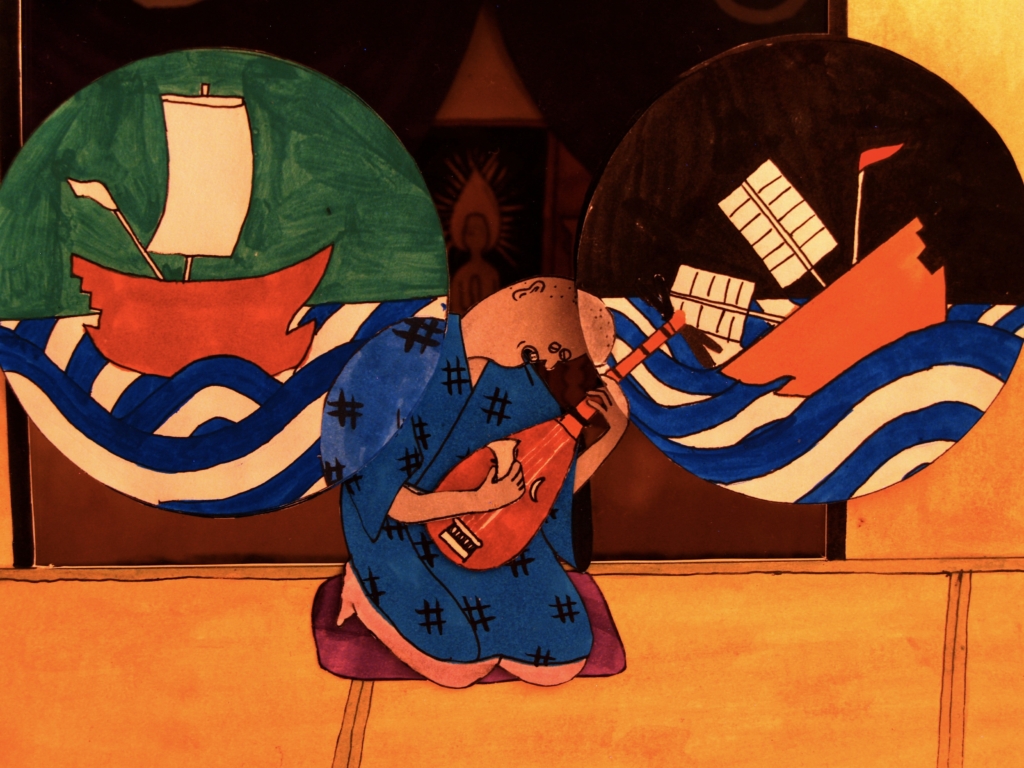
Finally, please tell us about your new work in progress, Hoichi.
TSUCHIYA: This work is based on the classic Japanese ghost story Hoichi the Earless. Hoichi the Earless became known through Kwaidan (1904) written by Lafcadio Hearn, but similar stories have been told since long before that.
Animation has a history of engaging with adaptations of the classics. For example, Yuri Norstein’s unfinished work The Overcoat or YAMAMURA Koji’s Mt. Head (2002). When I thought about what I could create in that current, Hoichi the Earless came to mind. Hoichi the Earless doesn’t have an easily readable moral lesson; rather, it leaves room for interpretation by the reader. It’s a ghost story, but the protagonist is a blind biwa player, and it includes a perspective on minorities. I think it’s a very complex work. I’ve been attracted to the story of Hoichi the Earless for a long time.
DOI Nobuaki, an advisor to NeW NeW, recommended introducing intertitles because overseas audiences are not familiar with Hoichi the Earless. I want to be conscious of how to make classic Japanese stories understandable to overseas audiences.
What do you want to express in this new work?
TSUCHIYA: In adapting it to video, I think it would be interesting to incorporate a style like abstract animation. On the other hand, I don’t want it to develop simply abstractly, but I also want to make the flow of the character’s heart understandable. It is also a challenge to see how I can depict the perspective of a blind person named Hoichi using visual expression called animation. While combining these elements, I hope to also express the indigenous nature of Japan.